

The Strategic Anchor: Why Baseline Schedules are the Bedrock of Infrastructure Success
In the world of large-scale infrastructure construction, where projects often span years and involve billions in capital, the difference between a successful delivery and a high-profile failure often comes down to one document: the baseline schedule. Far from being a mere administrative requirement, a robust baseline schedule serves as the project's "North Star," providing a definitive roadmap against which all progress is measured and all disruptions are judged.
The Blueprint for Execution
The primary role of a baseline schedule is to facilitate comprehensive planning. Before a single shovel hits the ground, the baseline forces the project team to visualize the entire sequence of works. It identifies the critical path—the sequence of activities that determines the shortest possible project duration. By mapping out dependencies between civil works, structural engineering, and utility relocations, the baseline allows managers to anticipate bottlenecks and optimize the sequence of operations for maximum efficiency.
Maintaining and Understanding Production
Once construction is underway, the baseline schedule transitions from a planning tool to a performance metric. It provides the "planned" data against which "actual" progress is compared.
Variance Analysis: By measuring actual progress against the baseline, project controls teams can identify early warning signs of slippage.
Production Trends: Understanding whether a crew is meeting planned daily output for concrete pours or tunneling allows for real-time adjustments to site management.
Predictive Insight: A well-maintained schedule helps forecast completion dates based on current production rates, allowing stakeholders to make informed decisions about resource surges or sequence changes.
Coordinating Assets: Labour and Equipment
Infrastructure projects are resource-intensive. Coordinating the mobilization of specialized labour and heavy equipment—such as tunnel boring machines, cranes, or earth-moving fleets—requires precision.
The baseline schedule provides the necessary timeline for procurement and logistics teams. It ensures that specialized subcontractors arrive precisely when the site is ready for them, minimizing idle time and avoiding the exorbitant costs associated with "standby" equipment. Without this central coordination tool, asset management becomes reactive, leading to chaotic site conditions and budget overruns.
The Shield Against Claims: Supporting Extensions of Time
Perhaps the most critical function of a baseline schedule is its role in legal and contractual protection. In infrastructure construction, delays are often inevitable due to unforeseen ground conditions, weather events, or design changes. When these delays occur, the baseline schedule becomes the primary evidence for any Extension of Time (EOT) claim.
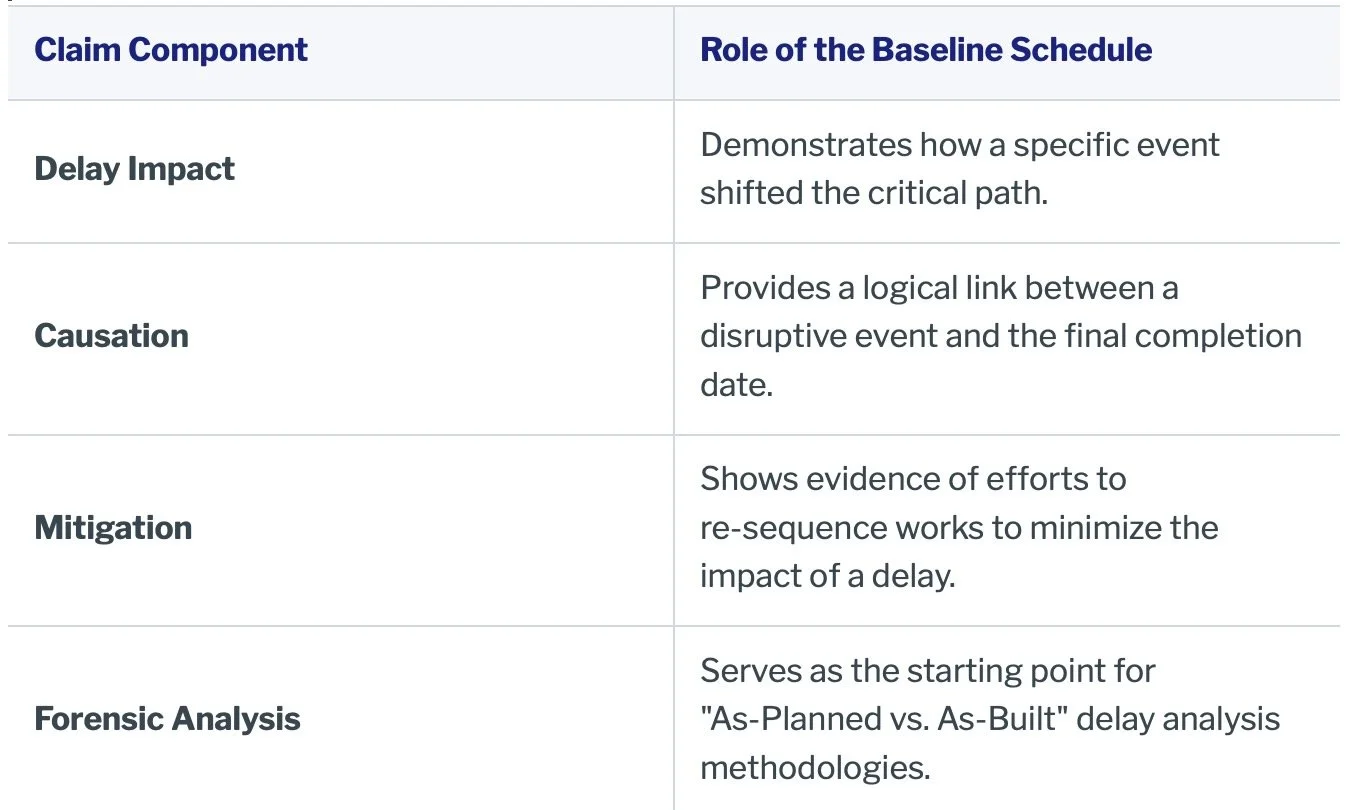
Without a contractually approved baseline, a contractor’s ability to prove their entitlement to more time or cost is severely compromised. It is the yardstick by which "delay" is defined; without it, there is no objective measure of what was supposed to happen, making it nearly impossible to hold parties accountable or recover costs.
Conclusion
A baseline schedule is much more than a Gantt chart on a wall. It is a dynamic management tool that integrates planning, production, resource coordination, and risk management. For infrastructure leaders, investing the time and expertise to develop a high-quality baseline at the project’s outset is not just a best practice—it is an essential strategy for project survival.
Ready to Build Smarter?
To discuss your project's scheduling needs or to find out how a comprehensive baseline schedule can protect your investment, reach out to Pillar Strategy Group today.